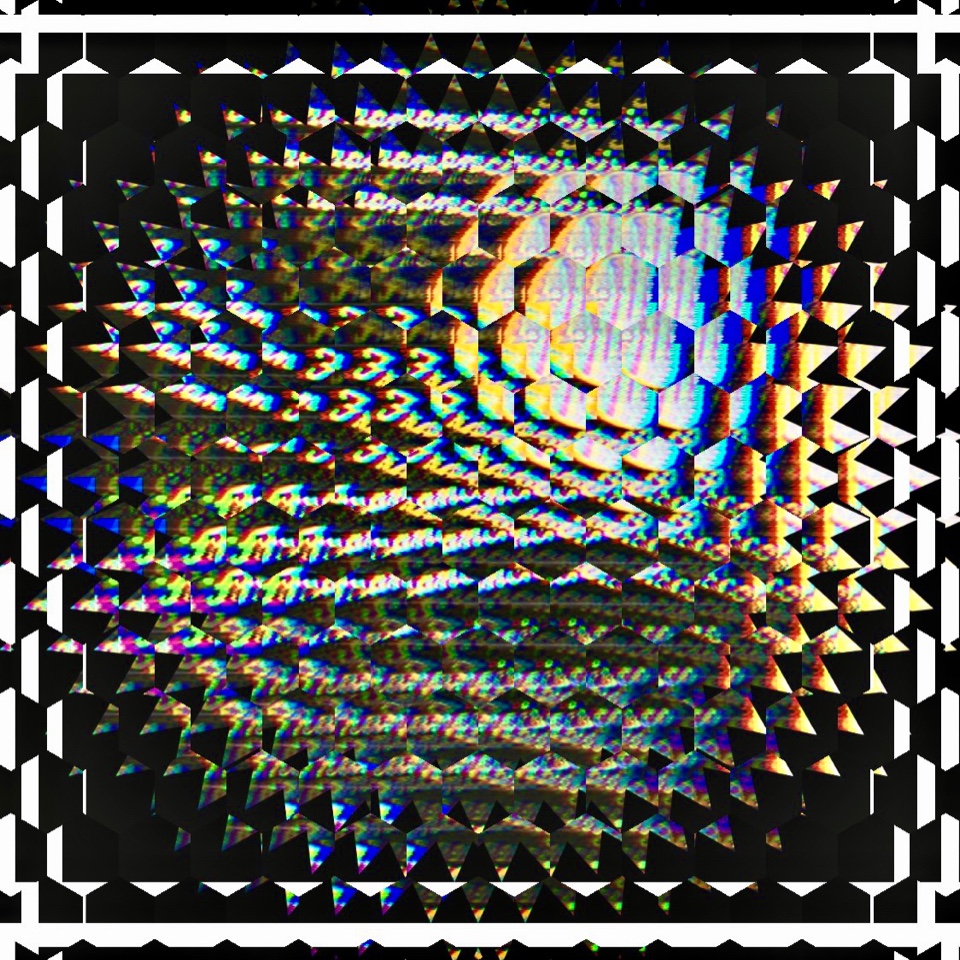
A digital art and interviews project by Nathan D. Horowitz and Nicola Winborn
Nicola Winborn speaks to Marsh Flower Press
Marsh Flower Press: What digital tools, Apps, processes etc. do you use in your art practice? Which ones have you used in ‘26 Visions – A Collaboration’?
Nicola: There is nobody more surprised than myself to find that I am producing digital visual art, that I am enjoying it and that I am often satisfied with the results. Overall, my preference is to make art using analogue processes; however, in the last twelve months, I have found myself drawn to digital methods, particularly glitching.
I currently use four Apps for this: Glitch Studio; Ultrapop; Rookie Cam; and Pic Grid Collage. Glitch Studio is my favourite of the four and the one I use most frequently. I also sometimes create digital art using AI – so far I’ve used Dall-E for this. When I use Dall-E I also combine the results from AI with glitching and colour filters etc. I prefer to use AI in this way, as it means the AI gets layered under other methods, and I really enjoy the way AI combines with stratification visually.
For the set of images I’ve created for this particular project no AI has been used, just mobile phone Apps – mainly Glitch Studio and occasionally Ultrapop. I’ve also utilised post-production photo editing techniques – like cropping – to generate this set of art works.
Marsh Flower Press: What first drew you to the original analogue art work your sets of digital images are based on?
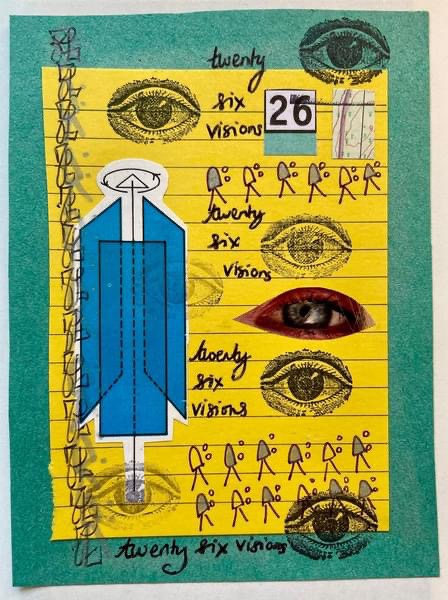
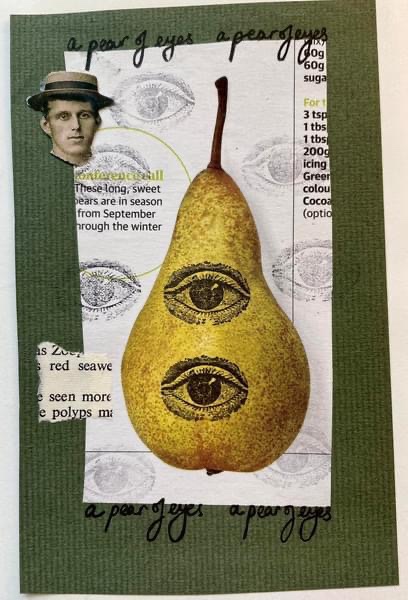
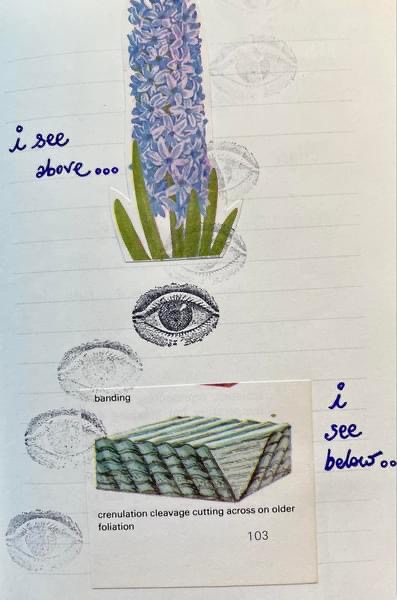
Nicola: I was drawn to the original analogue collages that these digital images are based on when I was revisiting a sketchbook I had kept over the Covid lockdowns. In this particular trio of collages, one of the main visual motifs is impressions from an eye rubber stamp I have from a commercial set. I have also used puns on words in these pieces: the eye rubber stamp impressions appear alongside a pear fruit, and so I then wrote “a pear of eyes” across the collage multiple times. When I first started glitching about a year ago, I started to see my analogue works anew. This particular set of collages jumped out at me straight away – they were begging to be glitched!
Marsh Flower Press: How do you respond to the digital images you’ve created here?
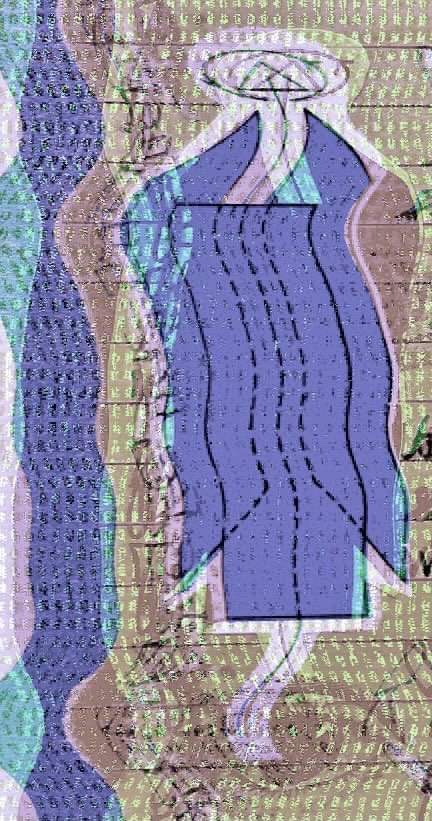
Nicola: One of the aspects of these digital images which I enjoy the most – both in terms of the process of making them and in terms of the ‘final’ pieces – is their intense focus on small but powerful details. Each one utilises a single tiny corner of the larger original analogue collage.
I am an ex-Biochemist, and therefore spent many years journeying with an electron microscope. Microscopic study was one of my favourite aspects of Biochemistry! I loved everything about it, from the lengthy and often laborious process of preparing slides/samples, to gazing in wonder at the final images in all their glory. I especially enjoyed drawing or photographing the cellular structures that electron microscopy made visible to us.
When I glitch my analogue art, I feel like I am reunited with my beloved electron microscopes of the past. Digital Apps, glitching and the tools available in mobile phone photography, mean that my tiny hand-held device becomes a powerful observation tool for me! It allows me to journey across the vast terrain of an analogue art work, zooming in and sampling as I go. As I travel, I gather my slides, my samples. Moreover, further glitching and cropping etc., allows me to delve even further and deeper into the microscopic infinity available in the tiniest piece of paper. As I create, as I play, dimension upon dimension cracks open before me and I feel that I am touched by the eternal.
Marsh Flower Press: Some observers and practitioners are not comfortable with digital art, particularly AI applications. How do you feel about this disquiet?
Nicola: I have mixed feelings about digital/AI applications. I understand the disquiet, the warnings, however, I also believe that artists have a right to explore these tools for themselves, if they so wish. Our computer technology dominated culture often makes me feel alienated, especially the hard line utilitarian aspects of it. Computers, data, shiny plastic and metal surfaces, endless screens – all of these impenetrable forms can feel unyielding to artists, creatives, poets and right-brained dreamers. (Personally, I have a particular aversion to the unique smell one finds in mobile phone shops or in electrical stores. It’s a mind-numbing odour of melting plastic and fried metal. Some like it, finding it ‘new’, ‘novel’ or ‘exciting’. I am someone who finds this aroma terrifying, as it feels like the last fragrance we are going to be left with when the tech apocalypse finally goes into overdrive.) Since ‘big tech’ can make me feel so fed up and disengaged, I therefore enjoy anything computer-based which actually invites me in and makes me feel welcome. As a creative who primarily works in analogue, I absolutely feel embraced by the digital tools I’ve opted to make use of – this is refreshing for me and it’s an experience I want to enjoy as much as I can.
Next week: we return to the visual work of this project with Chapter 3 by Nicola Winborn
 Marsh Flower Press